

Arrays in Data structure and Algorithms
Array is one of the most important topic in DSA as it is used in every other topic so it is the basic necessity for solving DSA problems
Introduction
What is DSA ?
Nothing but a contagious way to store data of similar datatype ( eg: int, string , char etc )
Ways to declare an Array ?
- C-style Array (fixed-size on stack)
int arr[5];            // uninitialized
int arr2[5] = {1, 2};  // {1, 2, 0, 0, 0}
int arr3[] = {1, 2, 3}; // size inferred: 3
- std::array (C++11+, fixed size, safer than C-array)
#include <array>

std::array<int, 5> arr;                 // default-initialized
std::array<int, 5> arr2 = {1, 2, 3};    // {1, 2, 3, 0, 0}
Size is fixed at compile time
Has
.size(),.at(),.begin(),.end(), etc.
3. std::vector (dynamic size, most common in CP)
#include <vector>

std::vector<int> v;                         // empty
std::vector<int> v2(5);                     // {0, 0, 0, 0, 0}
std::vector<int> v3(5, 7);                  // {7, 7, 7, 7, 7}
std::vector<int> v4 = {1, 2, 3, 4};         // list initialization
Size can grow/shrink
Preferred in competitive programming / DSA
Has
.push_back(),.resize(), etc.
4. Dynamic Array via new/delete (Heap allocation)
int* arr = new int[5];       // uninitialized
delete[] arr;                // don't forget to delete
Problems
Basic Problems are
Linear Search
Largest Element
Second Largest Element
Maximum Consecutive Ones
Left Rotate Array by One
Left Rotate Array by k Places
» Other Problems are
Move Zeros to End code
Two Pointer approach
Keep both pointer at start
s = 0 , m = 0mscans all the elementssstays at index where next non-zero element should goand if
mptr is at some non-zero element then swap the element withsptrand move both ptr by one
if
mptr is at 0 then just move it furtherIt will make sure that your
before
sall the elements are non zero andswill be swiping out your zeros to endand as your
mptr is not moving any zero, it is moving only non zero to ptrsso all zero will eventually be by handledsand will be [ushed to end
Remove duplicates from sorted array code
Two Pointer
Define two ptrs curr = 0 , next = 0
currstays at a index before which no duplicates existnextScans the array and finds next distinct element to be placed aftercurr
How it works
nextptr picks an element and compares it with element atcurriif they are same
nextmoves ahead by one stepif they are different moves
currby one step and and then swaps element atcurrwith element atnextand movesnextby one
Return curr + 1 as length of subarray from
0 to curr
Find missing number code
math
Just calculate sum of first
nnumberscalculate the sum of elements of array
return their abs(difference)
Union of two sorted arrays code
two pointer
The union of two arrays is an array where all values are distinct and are present in either the first array, the second array, or both.
» Brute Force : using set
» Optimal : using two ptrs
How it works
» Will use power of arrays being sorted
ptr1 = 0for first arrayptr2 = 0for second arraynow run a loop till either of ptrs hit size of respective arrays
and also make sure you skip all the duplicates in one array itself by internal
while loopsand keep inserting unique and distinct elements in ans array
and if any array has elements that are not pushed in ans array just push it in ans array
return ans
Intersection of two sorted arrays code
two ptr
The intersection of two arrays is an array where all values are present in both arrays.
Same as union of arrays but here duplicated elements are allowed as they have same number of copies in each array
- just push element to ans array if both array has it
Leaders in an Array code
Just as question says
A leader in an array is an element whose value is strictly greater than all elements to its right in the given array. The rightmost element is always a leader. The elements in the leader array must appear in the order they appear in the nums array.
Rearrange array elements by sign code
define two arrays
one for positive elements
one for negative elements
now place values from these two array to original array as requested in Problem statement
Other way would be
Create a new array<ans array> of same size and place elements in the ans array directly from given array using two pointers :
one for positive elements at even indices
one for negative elements at odd indices
Print the matrix in spiral manner code
Do just as question says
will be solved using 4 ptrs
l = 0,r = cols-1,t=0,b = rows- 1
While moving pointers keep in mind about the bound or limit of how far a point can go
Pascal's Triangle
math
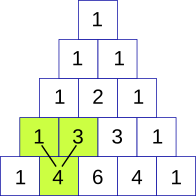
The first row has one element with a value of 1.
Each row has one more element in it than its previous row.
The value of each element is equal to the sum of the elements directly above it when arranged in a triangle format.
For pascal triangle there are three type of questions
Print an Element at r rows and c cols of Pascal’s Triangle code
$$\text{required_ans} = \binom{r - 1}{c - 1}$$
» Brute : Find factorial multiple times
» Optimal : Use formula
$$(n/1 )* ((n-1)/2) * ...$$
example :
for n = 10 and r = 7
$$\binom{10}{7} = (10/1)((10 - 1)/2)((10 - 2)/3)$$
Print each element of rth row code
        for row 4
        simulating

        1    1*3/1    (1 * 3 * 2)/( 1 * 2)     (1 * 3 * 2 *1)/(1 * 2 * 3)
        1    3         3                          1
here first element is
1next element will be found by
if x is
ithelementthen
(i+1)thelementand it is in
nthrowthen
$$\text{required_ans} = (1*(n-1)(n-2)...(n-i+1))/ (123...*i)$$
Print all n rows of pascal triangle from row 1
code
Just repeat 2nd problem solution for each row
or
just implement what it is
The first row has one element with a value of 1.
Each row has one more element in it than its previous row.
The value of each element is equal to the sum of the elements directly above it when arranged in a triangle format
Rotate matrix by 90 degrees code
- Transpose → reverse each row
Two Sum code
using map if order of element in ans has to be same
can also use sort
Three Sum code
Sorting is required
Also as it is asking about unique combinations of elements to sum to
0Think about using a setHere three pointers will be used
one will be fixed at ith position (i = 0 → n-1)
other two will apply two sum in remaining elements and will compare three sum by adding value of item at ith index
Four Sum code
Same as three sum
- Fix left most element and for rest elements apply three sum
Sort an array of 0's 1's and 2's : Dutch National Flag algorithm code
may have to use 3 pointers
s = 0: before which all zeroes will be presentm = 0: middle pointerresponsible for placing 0s and 2s at their desired positione = n-1: after which all twos will be present
Steps
for m → 0 to e
arr[m] == 1 : m++ and continue
arr[m] == 0 : swap element at m with elem at s and m++ and s++
arr[m] == 2 : swap element at m with elem at e and m++ and e—
Kadane's Algorithm code
assume maxSum is minimum possible value
then iterate and keep adding every element to sum and compare it with maxSum
if sum < 0 set sum = 0 and keep doing the same
Next Permutation code
The next permutation of an array of integers is the next lexicographically greater permutation of its integers.
More formally, if all the permutations of the array are sorted in lexicographical order, then the next permutation of that array is the permutation that follows it in the sorted order.
example :
for 1 3 2
next permutation is number strictly greater then this → 2 1 3
Steps
Find the element for which arr[i] < arr[i+1]
where i = n-2 → 0now pivot at that index i
find the first element on right part of pivot which is greater then item at i
swap it at i and with item found at previous step
now reverse the right part of pivot
excluding the ith element
Majority Element I : Moore's voting algorithm code
The majority element of an array is an element that appears more than n/2 times in the array. The array is guaranteed to have a majority element.
In this algorithm we keep track of
ans : element which is desired
cnt : freq of how many times ans repeated it self in the array
Steps
for every value of i ; i = 0→ n-1
if cnt = 0 : we assume this is the ans
if cnt ≠ 0
if ans = arr[i] : cnt++
else : cnt—
now we will have a value in ans which is the possible ans as if element is appearing more than n/2 times means it will be the last one in ans variable
however it is possible that no item appear more that n/2 times ,
hence we count the freq of ans in complete array using for loop over complete array
if it satisfies the condition of majority element: our ans
else return -1
Majority Element-II code
all elements which appear more than n/3
Modification to moore voting element
- Only two possible ans will exist
Find the repeating and missing number code
A math problem always prefer it’s coding solution
solved using generation equations of sum of first n elements and sum of first n*n elements
Count Inversions code
Brute force: Generate all pairs by scanning all other elements for each selected elements and return count of such numbers
optimal : merge sort
Maximum product sub array in an Array code : todo
concept of prefix product and suffix product
for even number of negative elements product of whole array will be positive
for odd number of negative elements there will be a single negative element that will cause whole product to be negative.
hence ans would be either right part of that element
or left part of that element
To handle case for zero just assign 1 to prefix product or suffix product if they get zero
For each iteration compare and store the max of suffix or prefix product or if prev stored was already bigger then move on
and return the final ans
Merge two sorted arrays without extra space code : todo
just make sure all them elements in one array are strictly smaller then all elements of other array
» Note : Array size of left array is given as total number of elements
Steps
Consider two arrays left , right array
point one ptr at end of left array
point second ptr at start of right array
traverse both such that elements in left always smaller then right
push all the elements from right to left array