
Why Version Control Exists: The Pendrive Problem
So before Git and GitHub, what existed?
Dinosaurs? Yes, technically.
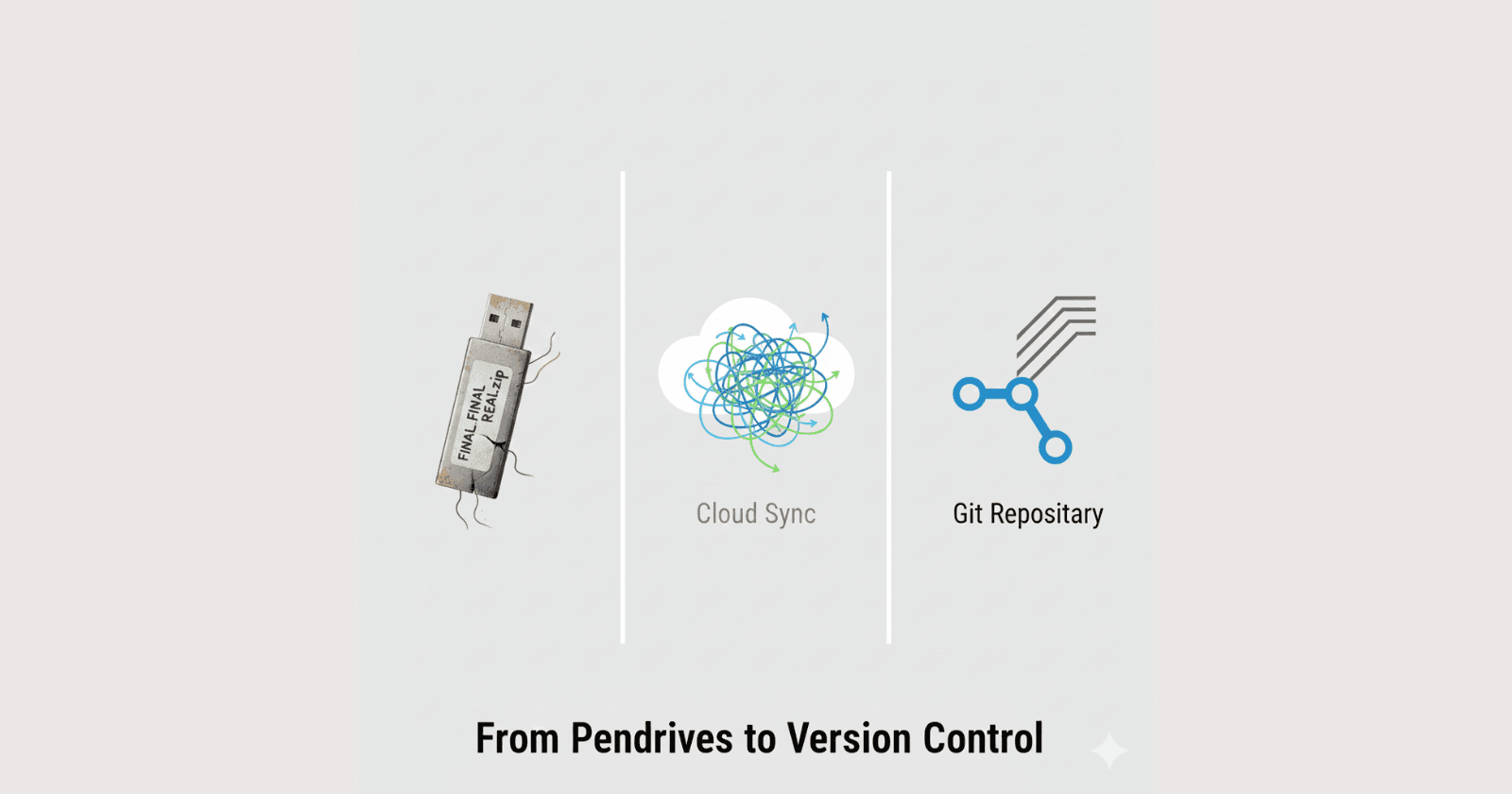
But after them, software developers entered a much darker age: the Plastic Era.
This was the time when code was shared using a sacred object known as the Pen Drive.
The Plastic Era of Code Sharing
If you’re wondering how code was shared using a pendrive, it’s exactly like managing a group PPT submission in college. You’ve seen these filenames:
Final_PPTFinal_submission_pptfinal_submission_latest.pptfinal_REAL_submission_v2.ppt
Most of the time, the only actual change was the theme color from blue to orange. Yet somehow, we had ten “versions” of the same file.
That was version control. Sort of. If you squint hard enough.
How the Pendrive Workflow Actually Worked
The process was dead simple:
Write code on your machine
Copy it to a pendrive
Hand the pendrive to another developer
They make changes
Copy it back
That pendrive became the single source of truth. Whoever had it owned reality.
This system looked cute and cooperative until someone said:
“Why did you make changes in this file when I was working on it?”
When Things Started Breaking
Imagine this scenario.
dev_1is building Feature A and createslib/utils.tsfor some helper functions.dev_3is building Feature C, completely unrelated.Irony hits. Both need a utility function.
Both create
lib/utils.ts.Both even name the function the same.
Output interfaces differ slightly.
Now merge those changes using a pendrive.
Congratulations, you’ve unlocked confusion.
Now multiply this problem across 60% of your codebase.
At this point:
You don’t know who wrote the function
You don’t know where it’s used
You don’t know which version is correct
You don’t know who to blame
Peak productivity.
Why the Pendrive Was the Problem
The pendrive wasn’t evil. It was just extremely bad at its job.
Some core issues:
Only one person could work at a time to avoid conflicts
Development speed was painfully slow
No credibility. Who wrote what? Who fixed what?
No history. Once something broke, it broke permanently
No version control, just vibes and backups
You might think, “Why not use final_v1, final_v2, etc.?”
Sure. But even a tiny change, like updating a theme color, required duplicating the entire project. Storage got wasted fast. Mental sanity even faster.
The First Obvious Fix: The Cloud
Next logical step: remove the physical object.
Instead of a pendrive:
Store code on the cloud
Developers download, modify, and upload again
This solved physical dependency, but not much else.
Problems still remained:
Logs were weak or manual
Versioning still meant duplicates
Storage costs increased
Collaboration conflicts still happened
So close. Still bad.
Enter Version Control Systems
Eventually, developers got tired of this nonsense and did what developers do best: build a system to fix it.
Version Control Systems (VCS) solved multiple problems at once:
Track who changed what
Maintain complete history
Optimize storage
Enable real collaboration
Allow safe merging, even on the same file
Version control stopped being optional. It became mandatory for any serious software.
Merge conflicts still hurt, but now they’re like a bad breakfast. Annoying, survivable, and not career-ending.
How Version Control Actually Solves the Issues
A Clear Mechanism
Files are organized and tracked systematically.Collaboration and Credibility
Developers work on branches. Every change has an owner.Space Optimization
Only changed files are stored as new versions. Everything else is referenced.
No unnecessary duplication. No guessing games.
Types of Version Control Systems
Local Version Control Systems (LVCS)
Changes are stored locally as patches on one machine.Centralized Version Control Systems (CVCS)
One central server holds the repository. Developers check out and commit changes.Distributed Version Control Systems (DVCS)
Every developer clones the full repository with complete history. This is where Git lives.
Conclusion
Version control exists because copying files is not collaboration.
The pendrive era taught developers a painful lesson:
code needs memory, ownership, and structure.